›[พื้นฐาน]บริการด้านเอกสารกฎหมายของ NYC Legal ครอบคลุมอะไร และไม่ครอบคลุมอะไร?
เราให้บริการจัดทำและตรวจร่างเอกสารทางกฎหมายที่ใช้ข้ามประเทศ ได้แก่ หนังสือมอบอำนาจ (Power of Attorney) หนังสือให้ความยินยอม (Consent Letter) คำให้การเป็นหนังสือ (Affidavit) คำรับรองตนเอง (Statutory Declaration) สัญญาซื้อขาย สัญญาจ้างงาน สัญญาเช่า สัญญาร่วมทุน บันทึกข้อตกลง MOU ข้อตกลงรักษาความลับ NDA พินัยกรรม การรับรองสำเนาถูกต้อง (Certified True Copy) พร้อมงานแปลและการรับรองลายมือชื่อโดยทนายความผู้ทำคำรับรองลายมือชื่อและเอกสาร (Notarial Services Attorney) และการประสานงานรับรองนิติกรณ์ที่กรมการกงสุลหรือขอ Apostille สิ่งที่เราไม่ทำคือรับประกันผลการพิจารณาของหน่วยงานปลายทาง เป็นตัวแทนของศาลหรือสถานทูต และไม่ให้บริการที่ขัดต่อกฎหมาย ค่าบริการและระยะเวลาดำเนินการสอบถามเจ้าหน้าที่ได้ทางโทรศัพท์ LINE หรืออีเมล
›[พื้นฐาน]ประเทศไทยมี Notary Public แบบระบบ common law หรือไม่?
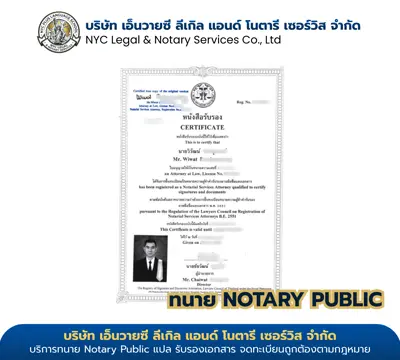
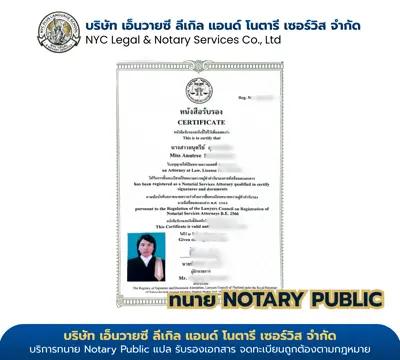
ประเทศไทยไม่มีตำแหน่ง Notary Public ตามระบบ common law งานที่เทียบเคียงกันดำเนินการโดยทนายความผู้ทำคำรับรองลายมือชื่อและเอกสาร (Notarial Services Attorney) ซึ่งเป็นทนายความที่ขึ้นทะเบียนกับสภาทนายความในพระบรมราชูปถัมภ์ตามข้อบังคับสภาทนายความว่าด้วยการขึ้นทะเบียนทนายความผู้ทำคำรับรองลายมือชื่อและเอกสาร ผู้ที่จะขึ้นทะเบียนได้ต้องมีใบอนุญาตว่าความและผ่านการอบรมหลักสูตรของสภาทนายความ ในทางปฏิบัติหน่วยงานต่างประเทศจำนวนมากยอมรับการรับรองของ NSA ในฐานะ notarial act ของประเทศไทย แต่ควรตรวจสอบข้อกำหนดของหน่วยงานปลายทางก่อนทุกครั้ง
›[พื้นฐาน]ตรวจสอบว่าทนายมีสิทธิรับรองเอกสาร (NSA) จริงหรือไม่ ทำได้อย่างไร?
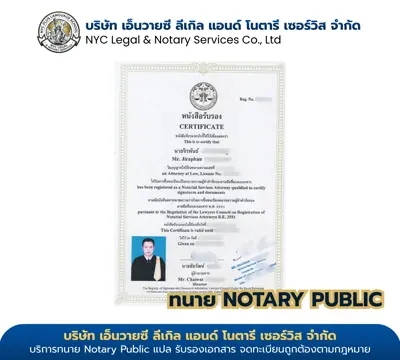
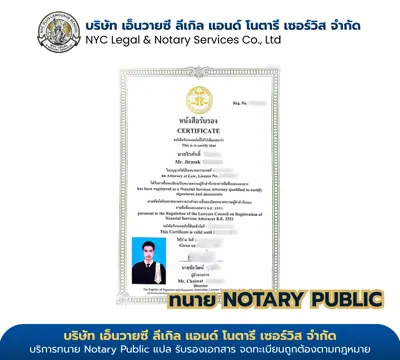
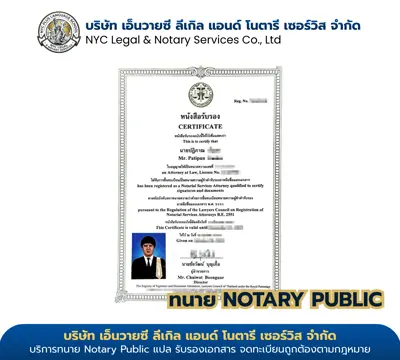
ขอดูใบอนุญาตว่าความและหนังสือรับรองการขึ้นทะเบียนเป็นทนายความผู้ทำคำรับรองลายมือชื่อและเอกสารที่ออกโดยสภาทนายความในพระบรมราชูปถัมภ์ ซึ่งจะระบุเลขทะเบียนและวันหมดอายุ ทนายที่ขึ้นทะเบียนจะประทับตราและลงลายมือชื่อพร้อมระบุเลขทะเบียนบนใบรับรอง (notarial certificate) ที่แนบกับเอกสาร หากหน่วยงานปลายทางต้องการยืนยันเพิ่ม สามารถนำเอกสารไปรับรองต่อที่กรมการกงสุลหรือขอ Apostille เพื่อยืนยันสถานะของผู้ลงนามอีกชั้นหนึ่ง
›[ขั้นตอนรับรอง]ขั้นตอนการรับรองเอกสารไทยเพื่อใช้ต่างประเทศมีกี่ชั้น?
โดยทั่วไปมี 3-4 ชั้นตามลำดับคือ (1) จัดทำหรือขอเอกสารต้นทาง เช่น เอกสารราชการจากอำเภอ กรมการปกครอง กรมพัฒนาธุรกิจการค้า หรือเอกสารเอกชนที่ลงนามต่อหน้าทนายผู้ทำคำรับรอง (2) แปลเป็นภาษาปลายทางหรือภาษาอังกฤษพร้อมคำรับรองคำแปล (3) รับรองนิติกรณ์ที่กองสัญชาติและนิติกรณ์ กรมการกงสุล กระทรวงการต่างประเทศ หรือขอ Apostille สำหรับประเทศที่เป็นภาคีอนุสัญญา และ (4) สำหรับประเทศที่ไม่ได้เป็นภาคี ต้องนำไปรับรองต่อที่สถานทูตหรือสถานกงสุลของประเทศปลายทางในประเทศไทยอีกชั้น ลำดับที่ถูกต้องขึ้นกับประเภทเอกสารและข้อกำหนดของหน่วยงานปลายทาง จึงควรยืนยันก่อนเริ่มดำเนินการ
›[ขั้นตอนรับรอง]ประเทศไทยเข้าเป็นภาคีอนุสัญญา Apostille เมื่อใด และมีผลอย่างไร?
อนุสัญญา Apostille (HCCH Convention of 5 October 1961 Abolishing the Requirement of Legalisation for Foreign Public Documents) มีผลใช้บังคับกับประเทศไทยตั้งแต่วันที่ 2 ธันวาคม 2568 ผลคือเอกสารมหาชนของไทยที่จะนำไปใช้ในประเทศภาคีอื่นสามารถขอ Apostille จากหน่วยงานผู้มีอำนาจของไทยได้ในขั้นตอนเดียว โดยไม่ต้องนำไปรับรองต่อที่สถานทูตของประเทศปลายทางอีก ในทางกลับกันเอกสารจากประเทศภาคีที่มี Apostille แล้วก็ใช้ในประเทศไทยได้โดยไม่ต้องผ่านสถานทูต อย่างไรก็ตามช่วงเปลี่ยนผ่านอาจมีหน่วยงานปลายทางบางแห่งยังขอเอกสารในรูปแบบเดิม จึงควรยืนยันกับหน่วยงานผู้รับก่อนยื่นทุกครั้ง รายชื่อภาคีปัจจุบันตรวจสอบได้ที่ hcch.net
›[ขั้นตอนรับรอง]ประเทศปลายทางไม่ได้เป็นภาคีอนุสัญญา Apostille ต้องทำอย่างไร?
ใช้เส้นทางรับรองแบบเดิม (consular legalisation) คือรับรองคำแปลและเอกสารที่กองสัญชาติและนิติกรณ์ กรมการกงสุล ก่อน แล้วจึงนำไปรับรองต่อที่สถานทูตหรือสถานกงสุลของประเทศปลายทางซึ่งตั้งอยู่ในประเทศไทย บางสถานทูตกำหนดให้ผู้ยื่นนัดหมายล่วงหน้า กำหนดภาษาของคำแปล จำนวนชุดสำเนา หรือรับเฉพาะเอกสารที่ออกไม่เกินระยะเวลาที่กำหนด เงื่อนไขเหล่านี้แตกต่างกันมากในแต่ละสถานทูตและเปลี่ยนแปลงได้ จึงควรตรวจสอบจากเว็บไซต์ทางการของสถานทูตนั้นก่อนดำเนินการ
›[ขั้นตอนรับรอง]กองสัญชาติและนิติกรณ์ กรมการกงสุล รับรองอะไรได้บ้าง?
งานนิติกรณ์ของกรมการกงสุล กระทรวงการต่างประเทศ ครอบคลุมการรับรองคำแปลเอกสารราชการไทยเป็นภาษาอังกฤษหรือจากภาษาอังกฤษเป็นภาษาไทย การรับรองลายมือชื่อเจ้าหน้าที่ผู้มีอำนาจในเอกสารราชการ การรับรองสำเนาเอกสารราชการ และการรับรองลายมือชื่อผู้ลงนามในเอกสารบางประเภทตามหลักเกณฑ์ที่กำหนด สิ่งที่กรมการกงสุลไม่ได้รับรองคือความถูกต้องของเนื้อหาสาระในเอกสาร รายละเอียดประเภทเอกสาร เอกสารประกอบ จำนวนวันทำการ และค่าธรรมเนียม ให้ตรวจสอบจาก consular.mfa.go.th ซึ่งเป็นแหล่งข้อมูลทางการที่เป็นปัจจุบันที่สุด
›[หนังสือมอบอำนาจ]หนังสือมอบอำนาจ (Power of Attorney) จัดทำและตรวจร่างอย่างไรให้ใช้ได้จริง?
หนังสือมอบอำนาจที่ใช้ได้จริงต้องระบุข้อมูลครบถ้วนอย่างน้อยดังนี้ ชื่อ-นามสกุลและเลขประจำตัวประชาชนหรือเลขหนังสือเดินทางของผู้มอบอำนาจและผู้รับมอบอำนาจให้ตรงกับเอกสารแสดงตน ขอบเขตอำนาจที่ชัดเจนเป็นรายการ เช่น ให้ยื่นคำขอ ลงนามในสัญญา รับเงิน หรือรับเอกสารแทน ระบุทรัพย์สินหรือธุรกรรมที่เกี่ยวข้องโดยละเอียด เช่น เลขที่โฉนดที่ดิน เลขที่บัญชี หรือเลขทะเบียนนิติบุคคล วันที่ทำและระยะเวลาสิ้นสุดอำนาจ ลายมือชื่อผู้มอบอำนาจและพยาน หากมอบอำนาจให้ทำนิติกรรมที่กฎหมายกำหนดแบบไว้ ต้องทำตามแบบนั้น ข้อผิดพลาดที่ทำให้เอกสารถูกตีกลับบ่อยที่สุดคือขอบเขตอำนาจกว้างเกินไปหรือแคบเกินไป ชื่อสะกดไม่ตรงหนังสือเดินทาง และไม่ได้แนบสำเนาบัตรประชาชนหรือหนังสือเดินทางที่ลงนามรับรองสำเนาถูกต้อง
›[หนังสือมอบอำนาจ]หนังสือมอบอำนาจให้ขายหรือโอนที่ดินในไทย ต้องใช้แบบฟอร์มของกรมที่ดินหรือไม่?
การมอบอำนาจให้ดำเนินการจดทะเบียนสิทธิและนิติกรรมเกี่ยวกับที่ดินหรือห้องชุดที่สำนักงานที่ดิน โดยทั่วไปเจ้าหน้าที่กำหนดให้ใช้แบบฟอร์มหนังสือมอบอำนาจของกรมที่ดิน (แบบ ท.ด.21 สำหรับที่ดิน และ อ.ช.21 สำหรับห้องชุด) พร้อมแนบสำเนาบัตรประชาชนหรือหนังสือเดินทางของทั้งสองฝ่ายที่รับรองสำเนาถูกต้อง ผู้มอบอำนาจที่อยู่ต่างประเทศมักต้องลงนามต่อหน้าเจ้าหน้าที่สถานทูตหรือสถานกงสุลไทย หรือลงนามต่อหน้า notary ในประเทศนั้นแล้วนำไปรับรองตามเส้นทาง Apostille หรือสถานทูตไทย ข้อกำหนดรายละเอียดต่างกันได้ตามสำนักงานที่ดินแต่ละแห่ง จึงควรโทรยืนยันกับสำนักงานที่ดินที่จะยื่นก่อนจัดทำเอกสาร ข้อมูลทางการดูได้ที่ dol.go.th
›[หนังสือมอบอำนาจ]หนังสือมอบอำนาจมีอายุนานเท่าไร และเพิกถอนได้อย่างไร?
กฎหมายไทยไม่ได้กำหนดอายุตายตัวของหนังสือมอบอำนาจทั่วไป อำนาจจะสิ้นสุดเมื่อครบกำหนดเวลาที่ระบุไว้ในเอกสาร เมื่อทำกิจการที่มอบหมายเสร็จสิ้น เมื่อผู้มอบอำนาจบอกเลิกการมอบอำนาจ หรือเมื่อคู่สัญญาฝ่ายใดฝ่ายหนึ่งถึงแก่ความตายหรือตกเป็นผู้ไร้ความสามารถ ตามหลักตัวแทนในประมวลกฎหมายแพ่งและพาณิชย์ ในทางปฏิบัติหน่วยงานผู้รับหลายแห่งกำหนดเองว่ารับหนังสือมอบอำนาจที่ออกไม่เกินระยะเวลาหนึ่ง จึงควรถามหน่วยงานปลายทางก่อน การเพิกถอนควรทำเป็นหนังสือ แจ้งผู้รับมอบอำนาจและแจ้งหน่วยงานหรือคู่สัญญาที่เกี่ยวข้องเป็นลายลักษณ์อักษร พร้อมเก็บหลักฐานการแจ้ง เพื่อป้องกันปัญหาการกระทำของตัวแทนภายหลังการเพิกถอน
›[หนังสือมอบอำนาจ]อยู่ต่างประเทศ จะทำหนังสือมอบอำนาจมาใช้ในไทยได้อย่างไร?
มีสองเส้นทางหลัก เส้นทางแรกคือลงนามต่อหน้าเจ้าหน้าที่กงสุลที่สถานเอกอัครราชทูตหรือสถานกงสุลใหญ่ของไทยในประเทศที่ท่านอยู่ ซึ่งเจ้าหน้าที่จะรับรองลายมือชื่อให้ เส้นทางที่สองคือลงนามต่อหน้า notary public ท้องถิ่น แล้วนำไปผ่านการรับรองตามระบบของประเทศนั้น หากประเทศนั้นเป็นภาคีอนุสัญญา Apostille ให้ขอ Apostille จากหน่วยงานผู้มีอำนาจ หากไม่ใช่ภาคี ให้นำไปรับรองที่กระทรวงการต่างประเทศของประเทศนั้นและสถานทูตไทย เอกสารที่เป็นภาษาต่างประเทศต้องแปลเป็นไทยและรับรองคำแปลก่อนใช้กับหน่วยงานราชการไทย ควรยืนยันเส้นทางที่หน่วยงานผู้รับในไทยยอมรับก่อนดำเนินการ
›[คำให้การและคำรับรอง]Affidavit กับ Statutory Declaration ต่างกันอย่างไร และทำในไทยได้หรือไม่?
Affidavit คือคำให้การเป็นหนังสือที่ผู้ให้ถ้อยคำสาบานหรือปฏิญาณว่าข้อความเป็นความจริงต่อหน้าผู้มีอำนาจรับคำสาบาน ส่วน Statutory Declaration เป็นคำรับรองตนเองตามกฎหมายที่ไม่ต้องสาบานแต่มีโทษหากให้ข้อความเท็จ ทั้งสองรูปแบบใช้มากในระบบ common law เช่น ออสเตรเลีย สหราชอาณาจักร แคนาดา นิวซีแลนด์ ในประเทศไทยสามารถจัดทำและลงนามต่อหน้าทนายความผู้ทำคำรับรองลายมือชื่อและเอกสาร ซึ่งจะรับรองว่าผู้ลงนามได้ลงนามต่อหน้าจริงและแสดงตนด้วยเอกสารใด สิ่งสำคัญคือต้องใช้แบบฟอร์มหรือถ้อยคำที่หน่วยงานปลายทางกำหนด เพราะบางหน่วยงาน เช่น หน่วยงานตรวจคนเข้าเมืองบางประเทศ ระบุแบบฟอร์มเฉพาะและถ้อยคำคำสาบานที่ต้องใช้
›[คำให้การและคำรับรอง]หนังสือให้ความยินยอม (Consent Letter) ใช้ในกรณีใดบ้าง และต้องมีอะไร?
ใช้บ่อยในกรณีบิดามารดายินยอมให้บุตรผู้เยาว์เดินทางไปต่างประเทศกับผู้ปกครองอีกฝ่ายหรือกับบุคคลที่สาม การยินยอมให้บุตรทำหนังสือเดินทาง การยินยอมของคู่สมรสในการทำนิติกรรมบางประเภท และการยินยอมให้ใช้ข้อมูลหรือภาพ เอกสารควรระบุชื่อผู้ให้ความยินยอมและความสัมพันธ์ ชื่อผู้เยาว์หรือผู้รับความยินยอม ขอบเขตและช่วงเวลาที่ยินยอม ประเทศหรือกิจกรรมที่เกี่ยวข้อง ข้อมูลการติดต่อของผู้ให้ความยินยอม พร้อมแนบสำเนาเอกสารแสดงตนและเอกสารแสดงความสัมพันธ์ เช่น สูติบัตรหรือทะเบียนบ้าน หลายประเทศแนะนำให้ลงนามต่อหน้าผู้มีอำนาจรับรอง จึงควรตรวจข้อกำหนดของสายการบินและหน่วยงานตรวจคนเข้าเมืองปลายทางก่อนเดินทาง
›[สัญญา]สัญญาสองภาษา ควรกำหนดให้ภาษาใดมีผลบังคับ?
สัญญาสองภาษาควรมีข้อสัญญาว่าด้วยภาษาที่ใช้บังคับ (governing language clause) ระบุชัดว่าหากถ้อยคำสองฉบับขัดกันให้ยึดฉบับภาษาใด หลักปฏิบัติที่พบบ่อยคือ หากคาดว่าข้อพิพาทจะขึ้นสู่ศาลไทย การเลือกภาษาไทยเป็นฉบับที่มีผลบังคับจะลดความเสี่ยงเรื่องการตีความ เพราะประมวลกฎหมายวิธีพิจารณาความแพ่ง มาตรา 46 กำหนดให้เอกสารภาษาต่างประเทศที่ยื่นต่อศาลต้องมีคำแปลภาษาไทยประกอบ หากคู่สัญญาเลือกอนุญาโตตุลาการที่ใช้ภาษาอังกฤษ การเลือกฉบับภาษาอังกฤษก็สมเหตุสมผล สิ่งที่ควรหลีกเลี่ยงคือการไม่ระบุเลย หรือระบุให้ทั้งสองฉบับมีผลเท่ากัน ซึ่งมักสร้างข้อพิพาทเรื่องการตีความในภายหลัง
›[สัญญา]สัญญาที่ทำในไทยจะเลือกใช้กฎหมายต่างประเทศได้หรือไม่?
โดยหลักทั่วไปคู่สัญญาในสัญญาทางพาณิชย์ระหว่างประเทศสามารถตกลงเลือกกฎหมายที่ใช้บังคับแก่สัญญาได้ แต่มีข้อจำกัดสำคัญคือ ศาลไทยจะไม่บังคับตามกฎหมายต่างประเทศในส่วนที่ขัดต่อความสงบเรียบร้อยหรือศีลธรรมอันดีของประชาชน และเรื่องบางประเภทอยู่ภายใต้กฎหมายไทยโดยเฉพาะไม่ว่าคู่สัญญาจะเลือกอย่างไร เช่น สิทธิในอสังหาริมทรัพย์ที่ตั้งอยู่ในประเทศไทย การจดทะเบียนสิทธิ กฎหมายคุ้มครองแรงงาน และกฎหมายคุ้มครองผู้บริโภคบางส่วน คำแนะนำเชิงปฏิบัติคือ กำหนดทั้งกฎหมายที่ใช้บังคับและเวทีระงับข้อพิพาทให้สอดคล้องกัน และปรึกษาทนายความก่อนลงนามในสัญญามูลค่าสูงหรือมีทรัพย์สินในหลายเขตอำนาจ
›[สัญญา]สัญญาซื้อขาย สัญญาเช่า สัญญาจ้างงาน มีจุดที่ต้องตรวจอะไรเป็นพิเศษ?
สัญญาซื้อขายควรตรวจการระบุทรัพย์สินให้ชัด เงื่อนไขการชำระราคา การส่งมอบและโอนกรรมสิทธิ์ ความรับผิดในความชำรุดบกพร่อง และเงื่อนไขการเลิกสัญญา สัญญาเช่าอสังหาริมทรัพย์ต้องระวังว่าการเช่าเกิน 3 ปีต้องจดทะเบียนต่อพนักงานเจ้าหน้าที่ มิฉะนั้นบังคับได้เพียง 3 ปี ตามประมวลกฎหมายแพ่งและพาณิชย์ สัญญาจ้างงานต้องสอดคล้องกับพระราชบัญญัติคุ้มครองแรงงาน เรื่องเวลาทำงาน วันหยุด ค่าล่วงเวลา และค่าชดเชยเมื่อเลิกจ้าง ซึ่งเป็นสิทธิขั้นต่ำที่ตกลงให้ต่ำกว่ากฎหมายไม่ได้ ทุกฉบับควรมีข้อกำหนดเรื่องภาษาที่ใช้บังคับ เวทีระงับข้อพิพาท และการแจ้งเตือนเป็นลายลักษณ์อักษร
›[สัญญา]MOU และ NDA ต่างจากสัญญาทั่วไปอย่างไร?
บันทึกข้อตกลง (MOU) มักใช้บันทึกความเข้าใจเบื้องต้นก่อนทำสัญญาฉบับสมบูรณ์ ผลผูกพันขึ้นกับถ้อยคำที่เขียน ไม่ได้ขึ้นกับชื่อเอกสาร หาก MOU กำหนดหน้าที่ที่ชัดเจนและแสดงเจตนาผูกพัน ศาลอาจถือว่ามีผลผูกพันได้ จึงควรระบุให้ชัดว่าข้อใดผูกพันและข้อใดไม่ผูกพัน ส่วนข้อตกลงรักษาความลับ (NDA) ควรนิยามข้อมูลที่เป็นความลับให้ชัด กำหนดวัตถุประสงค์ที่อนุญาตให้ใช้ ระยะเวลาคุ้มครองหลังสิ้นสุดความสัมพันธ์ ข้อยกเว้น เช่น ข้อมูลที่เป็นสาธารณะอยู่แล้ว หน้าที่คืนหรือทำลายข้อมูล และมาตรการเยียวยาเมื่อผิดสัญญา ทั้งสองประเภทหากคู่สัญญาต่างชาติจะลงนาม มักขอให้มีการรับรองลายมือชื่อโดยทนายผู้ทำคำรับรองด้วย
›[พินัยกรรมและมรดก]พินัยกรรมเขียนเองทั้งฉบับกับพินัยกรรมแบบมีพยาน ต่างกันอย่างไร?
ประมวลกฎหมายแพ่งและพาณิชย์ บรรพ 6 กำหนดแบบพินัยกรรมไว้หลายแบบ สองแบบที่พบบ่อยคือ พินัยกรรมแบบธรรมดา ซึ่งต้องทำเป็นหนังสือ ลงวัน เดือน ปีที่ทำ ผู้ทำพินัยกรรมลงลายมือชื่อต่อหน้าพยานอย่างน้อยสองคนพร้อมกัน และพยานลงลายมือชื่อรับรอง กับพินัยกรรมแบบเขียนเองทั้งฉบับ ซึ่งผู้ทำต้องเขียนข้อความ วัน เดือน ปี และลายมือชื่อด้วยลายมือตนเองทั้งหมด แบบหลังนี้ไม่ต้องมีพยาน แต่มีความเสี่ยงเรื่องการพิสูจน์ลายมือและข้อความคลุมเครือ ข้อควรระวังคือผู้รับทรัพย์ตามพินัยกรรมและคู่สมรสของผู้รับ ไม่ควรเป็นพยานหรือผู้เขียน เพราะกฎหมายกำหนดผลกระทบต่อการรับทรัพย์ในกรณีนั้น
›[พินัยกรรมและมรดก]ชาวต่างชาติทำพินัยกรรมเกี่ยวกับทรัพย์สินในประเทศไทยได้หรือไม่?
ทำได้ และในทางปฏิบัติแนะนำอย่างยิ่งสำหรับผู้ที่มีทรัพย์สินในไทย เช่น ห้องชุด บัญชีเงินฝาก หรือยานพาหนะ เพราะช่วยให้กระบวนการตั้งผู้จัดการมรดกต่อศาลไทยเร็วขึ้นและลดข้อพิพาท แนวปฏิบัติที่นิยมคือทำพินัยกรรมแยกฉบับสำหรับทรัพย์สินในประเทศไทยเป็นภาษาไทยหรือสองภาษา และระบุให้ชัดว่าพินัยกรรมฉบับนี้ใช้เฉพาะทรัพย์สินในไทยและไม่เพิกถอนพินัยกรรมในประเทศอื่น ควรตั้งผู้จัดการมรดกที่อยู่ในไทยหรือเข้าถึงกระบวนการศาลไทยได้ ทั้งนี้การจัดการมรดกยังต้องผ่านคำสั่งศาลตั้งผู้จัดการมรดกในกรณีทั่วไป ควรปรึกษาทนายความก่อนจัดทำ เพราะรายละเอียดขึ้นกับสัญชาติ ภูมิลำเนา และประเภททรัพย์สินของแต่ละราย
›[เอกสารบริษัท]หนังสือรับรองบริษัทและรายงานการประชุมผู้ถือหุ้น ใช้ในต่างประเทศต้องทำอย่างไร?
หนังสือรับรองนิติบุคคลออกโดยกรมพัฒนาธุรกิจการค้า (dbd.go.th) โดยทั่วไปควรขอฉบับที่ออกใหม่ เพราะหน่วยงานปลายทางหลายแห่งกำหนดว่าต้องออกไม่เกินระยะเวลาที่กำหนด จากนั้นแปลเป็นภาษาอังกฤษหรือภาษาปลายทางพร้อมคำรับรองคำแปล แล้วนำไปรับรองนิติกรณ์ที่กรมการกงสุลหรือขอ Apostille หากปลายทางเป็นประเทศภาคี ส่วนรายงานการประชุมผู้ถือหุ้นหรือคณะกรรมการเป็นเอกสารเอกชน จึงมักต้องให้กรรมการผู้มีอำนาจลงนามต่อหน้าทนายความผู้ทำคำรับรองลายมือชื่อและเอกสารก่อน แล้วจึงเข้าสู่ขั้นตอนรับรองชั้นถัดไป ควรตรวจสอบกับธนาคารหรือหน่วยงานปลายทางว่าต้องการชุดเอกสารและอายุเอกสารแบบใด
›[เอกสารบริษัท]เอกสารทรัพย์สินทางปัญญา สิทธิบัตร และเครื่องหมายการค้า ต้องรับรองอย่างไร?
การยื่นจดทะเบียนหรือโอนสิทธิในต่างประเทศมักต้องใช้หนังสือมอบอำนาจ (Power of Attorney) ตามแบบของสำนักงานทรัพย์สินทางปัญญาปลายทาง หนังสือโอนสิทธิ (Deed of Assignment) และเอกสารยืนยันสถานะนิติบุคคล เอกสารเหล่านี้เป็นเอกสารเอกชน จึงมักต้องลงนามต่อหน้าทนายผู้ทำคำรับรองลายมือชื่อและเอกสาร และบางประเทศกำหนดให้มี Apostille หรือการรับรองจากสถานทูตเพิ่ม สิ่งที่ควรระวังคือชื่อผู้ยื่นต้องตรงกับทะเบียนนิติบุคคลทุกตัวอักษร วันที่ลงนามต้องไม่หลังวันยื่นคำขอ และคำแปลต้องใช้ศัพท์เทคนิคที่สอดคล้องกับคำขอฉบับเดิม
›[ศาลและคดี]เอกสารภาษาต่างประเทศที่จะใช้ในศาลไทย ต้องแปลและรับรองอย่างไร?
ประมวลกฎหมายวิธีพิจารณาความแพ่ง มาตรา 46 วางหลักว่าเอกสารที่ยื่นต่อศาลต้องเป็นภาษาไทย หากเป็นภาษาต่างประเทศให้ยื่นพร้อมคำแปลภาษาไทยที่รับรองความถูกต้อง ในทางปฏิบัติคำแปลมักลงนามรับรองโดยผู้แปลพร้อมระบุคุณสมบัติ หรือรับรองโดยทนายความผู้ทำคำรับรองลายมือชื่อและเอกสาร ศาลมีอำนาจสั่งให้ทำคำแปลใหม่หรือให้แปลโดยผู้แปลที่ศาลเห็นสมควรได้หากมีข้อสงสัย คำแนะนำคือแปลให้ตรงตัวและครบถ้วนรวมถึงตราประทับและข้อความท้ายเอกสาร ไม่สรุปย่อ และยื่นต้นฉบับหรือสำเนาที่รับรองถูกต้องคู่กับคำแปลเสมอ
›[ศาลและคดี]คำพิพากษาของศาลต่างประเทศ นำมาบังคับคดีในประเทศไทยได้ทันทีหรือไม่?
ไม่ได้ทันที ประเทศไทยไม่มีกฎหมายรับรองและบังคับตามคำพิพากษาของศาลต่างประเทศเป็นการทั่วไป และไม่ได้เป็นภาคีอนุสัญญาระหว่างประเทศที่ให้บังคับคำพิพากษาต่างประเทศโดยตรง ในทางปฏิบัติผู้ชนะคดีต้องฟ้องเป็นคดีใหม่ในศาลไทย โดยอาจใช้คำพิพากษาต่างประเทศเป็นพยานหลักฐานประกอบ ซึ่งศาลไทยจะพิจารณาน้ำหนักตามรูปคดี ข้อยกเว้นสำคัญคือคำชี้ขาดของอนุญาโตตุลาการต่างประเทศ ซึ่งประเทศไทยเป็นภาคีอนุสัญญานิวยอร์ก ค.ศ. 1958 และมีพระราชบัญญัติอนุญาโตตุลาการรองรับการร้องขอให้ศาลไทยบังคับตามคำชี้ขาด ควรปรึกษาทนายความเพื่อประเมินแนวทางเป็นรายคดี
›[สำเนาและลายมือชื่อ]การรับรองสำเนาถูกต้อง (Certified True Copy) โดยทนาย ต่างจากรับรองโดยหน่วยงานราชการอย่างไร?
การรับรองโดยหน่วยงานผู้ออกเอกสาร เช่น สำนักทะเบียนอำเภอหรือกรมพัฒนาธุรกิจการค้า เป็นการยืนยันจากต้นทางว่าสำเนาตรงกับต้นฉบับในสารบบของหน่วยงาน ส่วนการรับรองโดยทนายความผู้ทำคำรับรองลายมือชื่อและเอกสาร เป็นการยืนยันว่าทนายได้เห็นต้นฉบับและสำเนานั้นตรงกับต้นฉบับที่แสดง ณ เวลานั้น ไม่ได้ยืนยันความถูกต้องแท้จริงของเนื้อหาต้นฉบับ หน่วยงานปลายทางบางแห่งรับเฉพาะสำเนาที่รับรองโดยหน่วยงานผู้ออก บางแห่งรับสำเนารับรองโดยทนายหรือ notary จึงต้องอ่านข้อกำหนดของผู้รับให้ชัดก่อนดำเนินการ เพื่อไม่ต้องทำซ้ำ
›[สำเนาและลายมือชื่อ]ลายมือชื่ออิเล็กทรอนิกส์ใช้ได้กับเอกสารประเภทใดในประเทศไทย?
พระราชบัญญัติว่าด้วยธุรกรรมทางอิเล็กทรอนิกส์ พ.ศ. 2544 และที่แก้ไขเพิ่มเติม วางหลักว่าข้อความและลายมือชื่อในรูปแบบข้อมูลอิเล็กทรอนิกส์จะปฏิเสธความมีผลทางกฎหมายเพียงเพราะอยู่ในรูปอิเล็กทรอนิกส์ไม่ได้ หากใช้วิธีการที่เชื่อถือได้ในการระบุตัวผู้ลงลายมือชื่อและแสดงเจตนา อย่างไรก็ตามธุรกรรมบางประเภทที่กฎหมายกำหนดแบบหรือกำหนดให้จดทะเบียนต่อพนักงานเจ้าหน้าที่ เช่น การโอนอสังหาริมทรัพย์ พินัยกรรม และเอกสารที่ต้องลงนามต่อหน้าเจ้าพนักงาน ยังต้องทำในรูปแบบกระดาษตามแบบที่กำหนด นอกจากนี้การรับรองลายมือชื่อโดยทนายผู้ทำคำรับรองตามข้อบังคับสภาทนายความ ตั้งอยู่บนหลักการที่ผู้ลงนามต้องลงนามต่อหน้า จึงควรตรวจสอบกับหน่วยงานปลายทางเป็นรายกรณี
›[สำเนาและลายมือชื่อ]พยานในการลงนามต้องมีกี่คน และใครเป็นพยานได้บ้าง?
จำนวนพยานขึ้นกับประเภทเอกสารและข้อกำหนดของหน่วยงานปลายทาง เอกสารทั่วไป เช่น หนังสือมอบอำนาจ นิยมใช้พยานสองคน พินัยกรรมแบบธรรมดาตามประมวลกฎหมายแพ่งและพาณิชย์ต้องมีพยานอย่างน้อยสองคนลงลายมือชื่อพร้อมกันต่อหน้าผู้ทำพินัยกรรม คุณสมบัติพยานที่ปลอดภัยที่สุดคือ บรรลุนิติภาวะ มีสติสัมปชัญญะสมบูรณ์ ไม่เป็นผู้มีส่วนได้เสียในเอกสาร ไม่ใช่ผู้รับประโยชน์หรือคู่สมรสของผู้รับประโยชน์ และสามารถติดต่อได้ภายหลังหากต้องยืนยันข้อเท็จจริง ควรบันทึกชื่อ-นามสกุล เลขบัตรประจำตัว และที่อยู่ของพยานไว้ในเอกสารด้วย
›[ภาษีและอากร]เอกสารประเภทใดต้องปิดอากรแสตมป์?
ประมวลรัษฎากรกำหนดบัญชีอัตราอากรแสตมป์สำหรับตราสารบางประเภท เช่น สัญญาเช่าที่ดินหรืออาคาร สัญญาจ้างทำของ สัญญากู้ยืมเงิน ใบมอบอำนาจ และตราสารอื่นตามบัญชีท้ายหมวดอากรแสตมป์ ตราสารที่ไม่ปิดอากรแสตมป์ให้ครบถ้วนอาจใช้เป็นพยานหลักฐานในคดีแพ่งไม่ได้จนกว่าจะเสียอากรและเงินเพิ่มให้ถูกต้อง ปัจจุบันตราสารบางประเภทที่ทำในรูปแบบอิเล็กทรอนิกส์ต้องชำระอากรผ่านระบบของกรมสรรพากร อัตราและวิธีชำระเปลี่ยนแปลงได้ตามประกาศกรมสรรพากร จึงควรตรวจสอบข้อมูลล่าสุดจาก rd.go.th หรือปรึกษาผู้เชี่ยวชาญด้านภาษีก่อนลงนามในตราสารมูลค่าสูง
›[การแปล]เอกสารกฎหมายต้องแปลเป็นภาษาอะไร และใครรับรองคำแปล?
ภาษาที่ต้องใช้กำหนดโดยหน่วยงานปลายทาง หากใช้กับหน่วยงานราชการไทยต้องเป็นภาษาไทย หากใช้ต่างประเทศส่วนใหญ่ต้องเป็นภาษาราชการของประเทศนั้นหรือภาษาอังกฤษ ผู้รับรองคำแปลก็ต่างกันตามปลายทาง กรมการกงสุลรับรองคำแปลเอกสารราชการตามหลักเกณฑ์ที่กำหนด หน่วยงานในออสเตรเลียส่วนใหญ่กำหนดให้คำแปลจัดทำโดยผู้แปลที่ได้รับการรับรองจาก NAATI สหราชอาณาจักรมักรับคำแปลที่มี certification statement ของผู้แปลหรือบริษัทแปล ส่วนบางประเทศในยุโรปกำหนดให้ใช้นักแปลสาบานตน (sworn translator) ที่ขึ้นทะเบียนกับศาลของประเทศนั้น ควรถามหน่วยงานผู้รับก่อนว่าต้องการรูปแบบใด เพื่อไม่ต้องแปลซ้ำ
›[การแปล]แปลสัญญาและเอกสารกฎหมาย ต้องระวังอะไรเป็นพิเศษ?
งานแปลกฎหมายต่างจากงานแปลทั่วไปตรงที่คำศัพท์หนึ่งคำอาจเปลี่ยนความรับผิดของคู่สัญญาได้ จุดที่ต้องระวังคือ ความสม่ำเสมอของคำนิยาม (defined terms) ตลอดทั้งฉบับ การแปลคำที่มีนัยทางกฎหมายเฉพาะระบบ เช่น trust, consideration, estoppel ซึ่งไม่มีคำตรงตัวในระบบกฎหมายไทย การรักษาโครงสร้างเลขข้อและการอ้างอิงข้ามข้อ ตัวเลข วันที่ สกุลเงิน และหน่วยวัด รวมถึงการแปลข้อความบนตราประทับและลายมือชื่อ แนวทางที่ปลอดภัยคือจัดทำอภิธานศัพท์ร่วมกับลูกค้าก่อนเริ่มงาน ใช้รูปแบบสองภาษาคู่ขนานเมื่อคู่สัญญาต้องอ่านทั้งสองภาษา และให้ทนายความตรวจทานคำแปลก่อนลงนาม
›[ข้อผิดพลาดที่พบบ่อย]ข้อผิดพลาดที่ทำให้เอกสารกฎหมายถูกตีกลับมีอะไรบ้าง?
ที่พบบ่อยที่สุดคือ (1) ชื่อ-นามสกุลสะกดไม่ตรงกับหนังสือเดินทางหรือบัตรประชาชน โดยเฉพาะการถอดอักษรไทยเป็นอังกฤษที่ไม่สม่ำเสมอกันในแต่ละเอกสาร (2) ลงนามไม่ครบทุกหน้าหรือไม่มีพยานตามที่กำหนด (3) ใช้แบบฟอร์มผิดเวอร์ชัน โดยเฉพาะแบบฟอร์มของหน่วยงานต่างประเทศที่ปรับปรุงบ่อย (4) ขาดขั้นตอนรับรองชั้นใดชั้นหนึ่ง เช่น มีคำแปลแต่ไม่ได้รับรองนิติกรณ์ (5) เอกสารเก่าเกินกว่าที่หน่วยงานปลายทางกำหนด (6) คำแปลไม่ครบ เช่น ไม่แปลตราประทับหรือข้อความท้ายเอกสาร และ (7) ขอบเขตอำนาจในหนังสือมอบอำนาจไม่ครอบคลุมการกระทำที่จะทำจริง วิธีป้องกันคือขอ checklist เป็นลายลักษณ์อักษรจากหน่วยงานผู้รับก่อนเริ่มดำเนินการ
›[ติดต่อและตรวจสอบ]ค่าบริการและระยะเวลาดำเนินการงานเอกสารกฎหมาย สอบถามได้ทางไหน?
สอบถามเจ้าหน้าที่ได้ทางโทรศัพท์ LINE Official และอีเมลของสำนักงาน เราไม่ประกาศอัตราค่าบริการตายตัวบนหน้าเว็บ เพราะขึ้นกับประเภทเอกสาร จำนวนหน้าและจำนวนชุด คู่ภาษา จำนวนขั้นตอนรับรองที่ต้องผ่าน (ทนายผู้ทำคำรับรอง กรมการกงสุล Apostille หรือสถานทูต) และความเร่งด่วน ส่วนค่าธรรมเนียมของหน่วยงานราชการเป็นอัตราที่หน่วยงานกำหนดและปรับปรุงได้ จึงควรยืนยันกับหน่วยงานนั้นโดยตรง เมื่อแจ้งรายละเอียดเอกสารและประเทศปลายทางมาให้ครบ เจ้าหน้าที่จะประเมินขั้นตอน ระยะเวลาโดยประมาณเป็นวันทำการ และค่าใช้จ่ายทั้งหมดให้ก่อนเริ่มงาน
›[ติดต่อและตรวจสอบ]ตรวจสอบข้อกำหนดล่าสุดของหน่วยงานปลายทางได้จากแหล่งใด?
แหล่งข้อมูลทางการที่ควรใช้เป็นหลักคือ กรมการกงสุล กระทรวงการต่างประเทศ (consular.mfa.go.th) สำหรับงานนิติกรณ์และ Apostille ของไทย เว็บไซต์ HCCH (hcch.net) สำหรับรายชื่อประเทศภาคีอนุสัญญา Apostille และสถานะการคัดค้าน สภาทนายความในพระบรมราชูปถัมภ์ (lawyerscouncil.or.th) สำหรับสถานะทนายความผู้ทำคำรับรอง กรมพัฒนาธุรกิจการค้า (dbd.go.th) สำหรับเอกสารนิติบุคคล กรมที่ดิน (dol.go.th) สำหรับแบบฟอร์มมอบอำนาจเกี่ยวกับที่ดิน กรมสรรพากร (rd.go.th) สำหรับอากรแสตมป์ และเว็บไซต์ทางการของสถานทูตหรือหน่วยงานปลายทางแต่ละแห่ง เนื่องจากระเบียบเปลี่ยนแปลงได้ ข้อมูลในหน้านี้จึงเป็นแนวทางทั่วไป ควรยืนยันกับหน่วยงานก่อนดำเนินการทุกครั้ง · ตรวจทานล่าสุด 2026-08-03
›[Basics]Does Thailand have a common-law Notary Public?
No. Thailand has no common-law notary public office. The equivalent function is performed by a Notarial Services Attorney (NSA) — a licensed Thai lawyer who has completed the Lawyers Council of Thailand training course and is registered under the Council's regulation on notarial services attorneys. An NSA can witness and certify signatures, certify true copies, administer affidavits and statutory declarations, and issue a notarial certificate bearing their registration number. Many foreign authorities accept an NSA certificate as Thailand's notarial act, but you should always confirm the receiving authority's own requirements before signing.
›[Basics]How can I verify that a lawyer is genuinely registered to notarise documents in Thailand?
Ask to see both the lawyer's licence to practise and the notarial-services registration certificate issued by the Lawyers Council of Thailand, which states the registration number and expiry date. A registered attorney signs and seals a notarial certificate attached to the document and states that registration number. If the receiving authority wants a further layer of verification, the document can be legalised at the Department of Consular Affairs or issued with an apostille.
›[Basics]What legal-document work does NYC Legal cover, and what does it not cover?
We draft and review cross-border legal instruments: powers of attorney, consent letters, affidavits, statutory declarations, sale and purchase agreements, employment contracts, leases, joint-venture agreements, memoranda of understanding, non-disclosure agreements, wills, and certified true copies. We also handle certified translation, signature certification by a Notarial Services Attorney, and coordination of consular legalisation or apostille. We do not guarantee the decision of any receiving authority, we do not act for any court or embassy, and we do not assist with unlawful instruments. Fees and turnaround times are quoted by our team by phone, LINE or email.
›[Legalisation]How many layers of certification does a Thai document need for use abroad?
Usually three to four, in order: (1) obtain or execute the source document — a public document from the district office or a government registry, or a private document signed before a Notarial Services Attorney; (2) have it translated into English or the destination language with a translator's certification; (3) legalise it at the Legalisation Division, Department of Consular Affairs, Ministry of Foreign Affairs, or obtain an apostille if the destination country is a Convention party; and (4) for non-party countries, obtain a further certification from that country's embassy or consulate in Thailand. The correct order depends on the document type and the receiving authority, so confirm before you start.
›[Legalisation]When did the Apostille Convention take effect for Thailand, and what changed?
The HCCH Convention of 5 October 1961 Abolishing the Requirement of Legalisation for Foreign Public Documents entered into force for Thailand on 2 December 2025. Thai public documents intended for use in another Convention party can now be apostillised by the Thai competent authority in a single step, without further embassy legalisation; conversely, apostillised documents from other parties can be used in Thailand without embassy certification. During the transition some receiving authorities may still ask for the older format, so confirm with the recipient before filing. The current list of parties is published at hcch.net.
›[Legalisation]The destination country is not an Apostille Convention party. What then?
Use the traditional consular legalisation route: certify the translation and document at the Legalisation Division of the Department of Consular Affairs first, then obtain certification from the destination country's embassy or consulate in Thailand. Some embassies require an appointment, prescribe the translation language, set the number of copies, or accept only recently issued documents. These requirements vary widely and change, so check that embassy's official website before proceeding.
›[Legalisation]What does the Department of Consular Affairs actually certify?
Its legalisation work covers certification of translations of Thai official documents into English (or from English into Thai), certification of the signature of the authorised official on an official document, certification of copies of official documents, and certification of signatures on certain categories of documents under its published criteria. It does not certify the substantive accuracy of the content. Document categories, supporting papers, processing days and fees should be checked at consular.mfa.go.th, the authoritative and most current source.
›[Power of attorney]How should a power of attorney be drafted so it is actually accepted?
At minimum it must state the full name and ID or passport number of both grantor and attorney exactly as they appear on identity documents; an itemised, clearly bounded scope of authority (for example filing an application, signing a contract, receiving funds or collecting documents); the specific asset or transaction concerned, such as a title-deed number, bank account number or company registration number; the execution date and expiry; and the grantor's signature with witnesses. If the underlying act has a statutory form, that form must be used. The most common reasons for rejection are a scope that is too broad or too narrow, name spellings that differ from the passport, and missing certified copies of identity documents.
›[Power of attorney]Does a land transfer in Thailand require the Department of Lands power-of-attorney form?
For registration of rights and juristic acts over land or a condominium unit at a Land Office, officials generally require the Department of Lands power-of-attorney form (T.D.21 for land, Or.Chor.21 for condominium units), together with certified copies of both parties' ID cards or passports. A grantor abroad usually signs before a Thai embassy or consulate officer, or before a local notary and then follows the apostille or Thai-embassy route. Requirements differ between Land Offices, so call the office where you will file before preparing documents. Official information is at dol.go.th.
›[Power of attorney]How long is a power of attorney valid and how is it revoked?
Validity is whatever the instrument states; if no expiry is given, some receiving authorities apply their own recency limits, and Thai banks and Land Offices often prefer a recently executed instrument. Revocation is done by a written notice of revocation delivered to the attorney and, in practice, also to every institution that holds the original — the revocation only protects you against third parties who have been notified. Where the power was registered or filed with an authority, file the revocation there too.
›[Affidavit]What is the difference between an affidavit and a statutory declaration?
An affidavit is a written statement of fact sworn or affirmed before an authorised officer, used chiefly as evidence in proceedings; a statutory declaration is a formal declaration of truth made under a statute without an oath, used chiefly for administrative purposes such as immigration, marriage or estate filings. In Thailand both are typically executed before a Notarial Services Attorney, who certifies the identity of the declarant and the fact of signing — not the truth of the content. Which form to use is dictated by the receiving authority, so ask them or send us their instructions.
›[Affidavit]Can a Thai notarial attorney certify a foreign-language affidavit?
Yes, an NSA can witness a signature on a document in a foreign language, and the notarial certificate is normally issued in English. If the document will be used before a Thai court or a Thai authority, section 46 of the Civil Procedure Code requires a Thai translation, so plan a certified Thai translation as part of the package. If the document goes abroad, check whether the receiving authority requires a translation into its own language and whether an apostille or embassy legalisation is needed.
›[Contracts]Which language should a cross-border contract be signed in?
Choose the language your dispute-resolution forum will use, and if you sign a bilingual version, add a governing-language clause stating which text prevails. For any filing before a Thai court or authority, a Thai translation is required under section 46 of the Civil Procedure Code. For registration with Thai government registries, the registry usually prescribes the acceptable language and format. Do not rely on informal translations for signature pages, monetary amounts or dates — those are the fields most often disputed.
›[Contracts]Do contracts in Thailand attract stamp duty?
Certain instruments listed in the Stamp Duty Schedule of the Revenue Code are dutiable — leases of land or buildings, hire-of-work agreements, loan agreements and powers of attorney among them — and the duty must be paid and the instrument duly stamped within the statutory period. An unstamped dutiable instrument can face a surcharge and may be inadmissible as evidence until stamped. Rates and procedure are published by the Revenue Department; ask our team about the specific instrument you are signing.
›[Contracts]Are electronic signatures valid for Thai legal documents?
The Electronic Transactions Act B.E. 2544 gives legal effect to electronic signatures that reliably identify the signatory and indicate approval of the content, and Thai authorities increasingly accept them. However, notarial certification, Land Office registration, wills, and many embassy or apostille procedures still require wet-ink originals or in-person signing. Ask the receiving authority whether an electronic signature is acceptable for that specific filing before signing electronically.
›[Wills]What are the valid forms of a will in Thailand?
Book VI of the Civil and Commercial Code recognises several forms, including a will in writing dated and signed by the testator before at least two witnesses present at the same time, a holograph will written entirely in the testator's own hand, a will made in the prescribed public form before a district officer, and secret-document and oral forms under limited conditions. Witnesses must be competent and must not be a beneficiary under the will. Because formal defects can invalidate the whole instrument, have the form checked against the assets and jurisdictions involved before signing.
›[Wills]Does a foreign will cover assets located in Thailand?
A foreign will can extend to Thai assets, but the Thai court will need the will itself, evidence of its validity where it was made, and — under section 46 of the Civil Procedure Code — a Thai translation, often with legalisation or an apostille. Many foreigners with Thai land, condominiums or bank accounts execute a separate Thai-form will limited to those assets to avoid delay and translation disputes. The right structure depends on the assets, so review both instruments together.
›[Certified copies]Who can certify a true copy for use abroad?
For private documents, a Notarial Services Attorney can certify a copy against the original that is produced to them. For Thai official documents, the issuing authority or the Department of Consular Affairs certifies copies, and many receiving authorities insist on that official route rather than a lawyer's certification. Ask the recipient which of the two they require: sending a lawyer-certified copy where a government-certified copy is demanded is one of the most frequent causes of rejection.
›[Corporate]Which corporate documents are commonly notarised or legalised for use abroad?
Typically the certificate of incorporation and affidavit of company registration, the list of shareholders, the memorandum and articles of association, board or shareholder resolutions, certificates of good standing, powers of attorney for signing abroad, and directors' identity documents. Thai company records are issued by the Department of Business Development (dbd.go.th), then translated, then legalised or apostillised. Banks and foreign registries often set a recency limit on these extracts, so check the deadline before ordering the set.
›[Corporate]Does a board resolution signed abroad need Thai certification?
If it will be filed with a Thai authority or bank, expect to provide the original resolution, a certified Thai translation under section 46 of the Civil Procedure Code, and proof of the signatories' authority. A resolution executed abroad is usually notarised locally and then apostillised, or legalised by the Thai embassy in that country where the apostille route is unavailable. Confirm the exact chain with the Thai receiving entity, because banks and registries can differ.
›[Translation]When must a legal document be translated into Thai?
Whenever it is submitted in a Thai court proceeding — section 46 of the Civil Procedure Code requires a Thai translation of foreign-language documents — and whenever a Thai authority, registry, bank or Land Office asks for one. Government offices normally require the translation to carry a translator's certification, and for cross-border chains the Department of Consular Affairs may need to certify the translation before the apostille or embassy stage. Order translation and certification as one package so the wording matches across every layer.
›[Translation]Do names and addresses have to be transliterated consistently?
Yes. Use the exact spelling shown on the passport or the ID document for every name, and keep one transliteration of company names and addresses across the contract, the translation, the notarial certificate and the legalisation stage. Inconsistent transliteration between layers is a very common cause of rejection at embassies and Land Offices, because the reviewing officer cannot verify that the documents refer to the same person or entity.
›[Process]What should I send you to get an accurate assessment?
Send the receiving authority's written instructions or checklist, the destination country, the deadline, a scan of the source document, the identity document of every signatory, and — for corporate matters — the current company extract. With those we can confirm the correct order of steps (drafting, notarial certification, translation, consular legalisation or apostille, embassy certification), the documents each stage requires, and the realistic timeline. Ask our team by phone, LINE or email for fees and current processing times.
›[Process]Can the whole process be handled if I am outside Thailand?
In most cases yes. Drafting and review are done remotely, documents you must sign personally are executed before a notary or Thai embassy officer where you are, and Thai-side steps such as obtaining registry extracts, translation and legalisation are handled here with a properly drafted power of attorney. What cannot be delegated is any act the law or the authority requires you to perform in person. Tell us where you are and what the recipient requires, and we will map which steps need your presence.
›[Process]Why do documents get rejected, and how do you prevent it?
The recurring causes are: a scope of authority that does not match the transaction, name spellings that differ from the passport, missing certified identity copies, the wrong certification route for the country (apostille versus embassy legalisation), a translation not certified as the authority requires, expired recency limits on registry extracts, and missing witness signatures. We work backwards from the receiving authority's own written checklist and verify each layer against it before the next layer is added, which is why we ask for that checklist at the start.
›[Limits]What do you not do, and why?
We do not guarantee the decision of any court, registry, embassy or immigration authority, because those decisions rest with the authority alone. We do not publish fees or government charges on this page, since they change and depend on the document set — ask our team by phone, LINE or email. We do not display reviews or ratings for these services. And we do not certify the truth of statements a client makes in an affidavit or declaration: notarial certification covers identity and the fact of signing, not the content.