›[Basics]Does Thailand have Notaries Public?
Thailand does not have a separate notary public office as in common-law countries. Instead, lawyers who complete the Lawyers Council of Thailand training and are registered as a Notarial Services Attorney may certify signatures and documents. Their certification is generally accepted abroad as notarisation, and for many destinations it is then further legalised by the Department of Consular Affairs or the destination embassy.
›[Basics]What exactly does a Notarial Services Attorney certify?
The attorney certifies facts they can personally witness: that a named person signed the document in front of them after showing valid identification, that a copy is a true copy of the original presented, that an oath or affirmation was administered, or that a signature specimen is genuine. The attorney does not certify that the statements inside the document are true — the signer remains responsible for the content.
›[Basics]Is a Thai notarised document valid overseas?
The notarisation itself is valid, but most foreign authorities also require a chain of authentication. Since 2 December 2025 Thailand is a party to the Apostille Convention, so for other contracting states an Apostille issued in Thailand replaces embassy legalisation. For non-contracting states you still need legalisation by the Department of Consular Affairs followed by the destination embassy or consulate.
›[Basics]How do I verify that a lawyer is genuinely authorised to notarise?
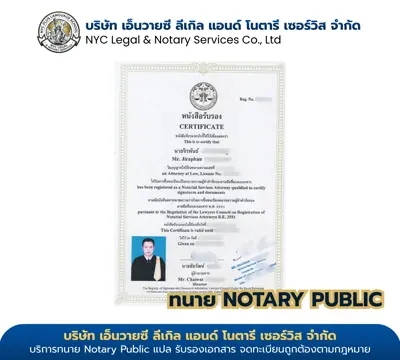
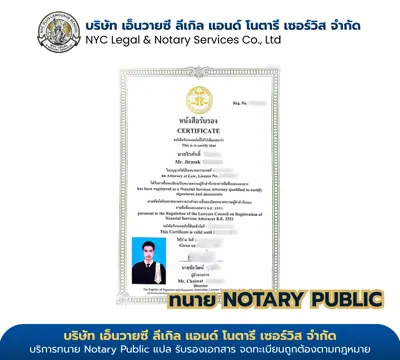
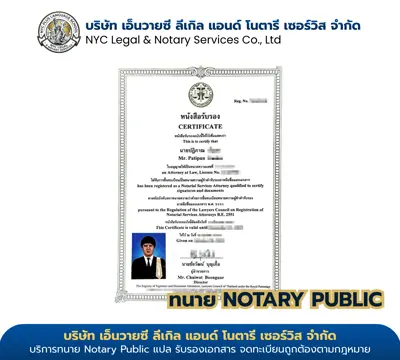
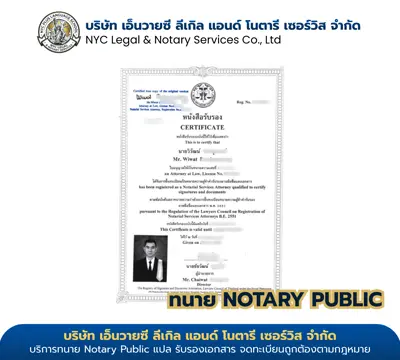
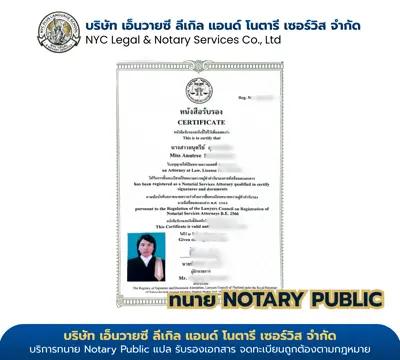
Ask for the attorney's lawyer licence number and their Notarial Services Attorney registration, then cross-check with the Lawyers Council of Thailand. A compliant certification page shows the attorney's name, licence details, the date, the certified act, and the attorney's seal and signature.
›[Basics]Can a notarisation be done in English?
Yes. Certification wording is commonly issued in English, or bilingually in Thai and English, so the receiving authority abroad can read it. If the underlying document is in Thai, most destinations also require a translation, and translations used abroad are usually certified by the Department of Consular Affairs rather than by the attorney.
›[Basics]Do I have to appear in person?
For any act where your signature or identity is certified — powers of attorney, affidavits, declarations, signature specimens — yes, you must sign in front of the attorney with your original passport or ID. Certified true copies do not require your signature, but the original document must be physically presented for comparison.
›[Basics]What identification do foreigners need?
An original valid passport is the standard requirement. Depending on the document, the attorney may also ask for your visa or entry stamp page, your work permit, or a residence certificate to confirm your address in Thailand. Photocopies alone are not sufficient.
›[Basics]Can a notarisation be done for someone who is not in Thailand?
No. The person whose signature is certified must be physically present before the attorney in Thailand. If the signer is abroad, they should notarise locally or at a Thai embassy or consulate, depending on where the document will be used.
›[Basics]How long does notarisation take?
A straightforward signature or true-copy certification is usually completed within the same appointment once documents are checked in advance. Timelines grow when the file also needs translation, Department of Consular Affairs legalisation, or embassy legalisation, because each of those steps runs on the authority's own processing schedule.
›[Basics]Is an electronic or scanned notarisation accepted?
Most destinations still require a wet-ink signature and an original seal on paper. Some authorities accept a scanned copy for preliminary review but will ask for the original before final acceptance. Confirm the format requirement with the receiving authority before choosing electronic delivery.
›[Power of Attorney]How do I notarise a power of attorney to be used overseas?
Prepare the power of attorney in the wording required by the receiving party abroad, including the agent's full legal name and the exact scope of authority. Sign it in front of the Notarial Services Attorney with your passport, then legalise the notarised document — Apostille for Apostille Convention states, or Department of Consular Affairs plus destination embassy for other states.
›[Power of Attorney]Can I notarise a power of attorney to sell property abroad?
Yes, the signature can be notarised in Thailand. However, property transactions are governed by the law where the property is located, so the wording, witness requirements and legalisation chain must follow the instructions of the foreign land registry, notary or lawyer handling the transfer. Always obtain their template before signing.
›[Power of Attorney]Does a power of attorney for a Thai bank need notarisation?
Thai banks generally have their own mandate forms and internal verification, so notarisation is not usually the deciding factor. Notarisation becomes relevant when the document is signed in Thailand for use with a bank or institution outside Thailand, or when the bank explicitly requires a notarised mandate.
›[Power of Attorney]Can two people be appointed in one power of attorney?
Yes, but state clearly whether the agents may act jointly or severally, because an ambiguous appointment is frequently rejected abroad. Each signer whose signature is being certified must appear before the attorney in person.
›[Power of Attorney]How long is a notarised power of attorney valid?
The notarisation itself does not expire, but the receiving authority usually sets a practical limit — commonly three to six months from the date of issue — and many registries also require that any supporting civil documents be recently issued. Check the destination's freshness rule before you legalise.
›[Power of Attorney]Can a company director sign a power of attorney on behalf of a Thai company?
Yes, provided the director has authority to bind the company. Bring a recent company affidavit or DBD certificate showing the authorised signatories and the company seal requirement, plus the director's ID or passport, so the attorney can confirm signing capacity.
›[Affidavits]What is an affidavit and when do I need one notarised?
An affidavit is a written statement of facts sworn or affirmed by the signer. Foreign authorities commonly request notarised affidavits for single status, name discrepancies, dependency, financial support, address confirmation or identity confirmation. The attorney administers the oath and certifies that you signed before them.
›[Affidavits]Can I notarise a single status or freedom to marry declaration?
Yes. Many registries abroad accept a notarised declaration of single status, but some require an official civil status record instead. For marriages registered in Thailand, the district office usually relies on your embassy's affirmation of freedom to marry, so verify which document the specific office requires before notarising.
›[Affidavits]Can I notarise a statutory declaration for a visa application?
Yes. Declarations covering relationship history, cohabitation, financial sponsorship or accommodation are commonly notarised. Note that immigration authorities weigh declarations alongside primary evidence, so attach supporting records such as tenancy agreements, transfer receipts or photographs where relevant.
›[Affidavits]Can a proof of life certificate be notarised for a foreign pension?
Yes, a proof of life or life certificate can be signed before a Notarial Services Attorney. Some pension authorities insist on their own form and on certification by an embassy or a specific official, so check the pension provider's instructions and use their template whenever one is supplied.
›[Affidavits]Can I notarise a translation accuracy declaration?
The attorney can certify the translator's signature on a declaration of accuracy. If the destination requires certification of the translation itself for official use, the standard Thai route is certification of the translation by the Department of Consular Affairs, and for Australian migration purposes a NAATI certified translation is usually required instead.
›[Certified Copies]How does a certified true copy work in Thailand?
You present the original document and the attorney compares it against the copy, then certifies that the copy is a true copy of the original shown. The original must be genuine and complete; the attorney cannot certify a copy made from another copy or from an unverified scan.
›[Certified Copies]Can my passport be certified as a true copy?
Yes, a copy of your passport biodata page — and visa or entry stamp pages if required — can be certified as a true copy when the original passport is presented. This is one of the most requested items for opening accounts, company registration and property matters abroad.
›[Certified Copies]Can a university degree or transcript be certified?
A copy can be certified as a true copy of the original presented. Universities and credential assessment bodies abroad often additionally require documents sent directly by the issuing institution, or a translation certified by the Department of Consular Affairs, so confirm their exact requirement before relying on notarisation alone.
›[Corporate]Which company documents are commonly notarised?
Typical items are the company affidavit and DBD registration certificate, the memorandum and articles of association, the shareholder list, board resolutions, certificates of incumbency, and signature specimens of authorised directors. These are usually needed to open a subsidiary, bid for a foreign tender, or register a distributor abroad.
›[Corporate]Can a board resolution be notarised for use abroad?
Yes. The authorised director signs the resolution in front of the attorney, who certifies the signature and signing capacity based on the company affidavit. If the destination requires an Apostille, the notarised resolution then goes through the Thai Apostille process.
›[Corporate]Do trade documents such as a Certificate of Origin need notarisation?
It depends on the importing country and the buyer's bank. Certificates of Origin are normally issued or endorsed by the Department of Foreign Trade or a chamber of commerce; notarisation is added when the buyer, customs authority or letter-of-credit terms specifically require a notarised copy or a notarised declaration accompanying the shipment.
›[Corporate]Can a distributor or agency agreement be notarised?
Yes. Signatures of the contracting parties can be certified, and copies of the executed agreement can be certified as true copies. Registration requirements for agency or distribution agreements vary by country, so confirm whether the destination also requires Apostille or embassy legalisation.
›[Apostille and Legalisation]What changed when Thailand joined the Apostille Convention?
The Apostille Convention entered into force for Thailand on 2 December 2025. For documents going to another contracting state, a single Apostille issued by the competent Thai authority now replaces the previous requirement of embassy legalisation. Documents for non-contracting states still follow the consular legalisation chain.
›[Apostille and Legalisation]Does an Apostille replace notarisation?
No. They are different steps. Notarisation authenticates the signature or the copy at source; the Apostille authenticates the official Thai signature and seal so that foreign authorities can accept it. Private documents normally need notarisation first, then the Apostille.
›[Apostille and Legalisation]How do I know whether my destination accepts an Apostille?
Check the current list of contracting parties on the HCCH website, and confirm with the receiving authority, because some states have specific objections or additional internal requirements. When in doubt, ask the receiving authority in writing which chain they will accept.
›[Apostille and Legalisation]What is the usual order of steps for a Thai document used abroad?
For Thai official documents: obtain a recent original, translate it, have the translation certified by the Department of Consular Affairs, then obtain the Apostille or embassy legalisation. For private documents drafted by you: notarise before the Notarial Services Attorney, then obtain the Apostille or the consular plus embassy legalisation chain.
›[Apostille and Legalisation]Can documents be legalised without the owner being in Thailand?
Legalisation steps can generally be handled by an authorised representative with a signed authorisation and copies of identification, because those steps do not require your personal appearance. Only the notarisation of your own signature requires you to attend in person.
›[Apostille and Legalisation]My documents were rejected abroad. What are the usual causes?
The most frequent causes are a missing step in the legalisation chain, an outdated civil document, wording that does not match the receiving authority's template, a translation that was not certified by the required body, and names that are inconsistent across documents. Fixing name inconsistency and using the destination's own template resolves most rejections.
›[For Expats]I live in Thailand — can I notarise documents for my home country here?
Yes, for private documents you sign yourself. Whether your home country accepts a Thai notarisation depends on its rules: many accept it with an Apostille, some require certification at your own embassy in Bangkok instead. Check with the receiving authority or your embassy before booking.
›[For Expats]Should I use my embassy or a Thai Notarial Services Attorney?
Use your embassy when the receiving authority specifically names embassy or consular certification, or when a national form must be witnessed by a consular officer. Use a Thai Notarial Services Attorney when the requirement is simply notarisation and the document will be authenticated by Apostille or consular legalisation afterwards.
›[For Expats]Can a notarised address confirmation be used for banking abroad?
It can support an application, but banks abroad usually specify which proof of address they accept, such as a utility bill, a tenancy agreement or an official residence certificate. A notarised declaration works best as a supplement rather than a substitute.
›[For Expats]Can documents for a foreign divorce or family court case be notarised?
Signatures on consent forms, affidavits and acknowledgements can be notarised, and copies of supporting documents can be certified. Court filing requirements and admissibility rules are set by the foreign court, so follow the instructions of the lawyer conducting the case in that jurisdiction.
›[For Expats]Can I notarise documents needed for overseas inheritance?
Yes for the private documents in the file — a power of attorney to a foreign lawyer, an affidavit of heirship, a renunciation of inheritance, or a certified copy of your passport. Thai civil records such as a death certificate follow the translation and consular certification route, and appointment of an estate administrator in Thailand requires a court order.
›[Australia and NAATI]Do Australian authorities accept a Thai notarisation?
Australia is a party to the Apostille Convention, so a Thai notarised private document with an Apostille is generally accepted. Separately, translations submitted to the Department of Home Affairs and most Australian institutions must be NAATI certified, which is a different requirement from notarisation.
›[Australia and NAATI]Do I need notarisation or a NAATI translation for an Australian visa?
For non-English documents you need a NAATI certified translation. Notarisation is only required when Home Affairs, a state authority, or an assessing body specifically asks for a notarised or certified copy of the original document. Many applicants need the translation only.
›[Australia and NAATI]Can one provider handle both notarisation and NAATI translation?
Yes. We coordinate the Notarial Services Attorney step, the NAATI certified translation, and any Apostille or consular legalisation as a single file so that names, dates and document references stay consistent across every certificate.
›[Process]What should I prepare before my appointment?
Bring the final document text, your original passport or ID, any template or instructions from the receiving authority, and the originals of any documents that will be copied. Sending drafts for review before the appointment avoids re-signing due to wording problems.
›[Process]Can documents be sent by post or courier?
Documents that only require a true-copy certification usually still need the original presented, so courier is possible for the return leg but not as a substitute for presenting originals. Documents requiring your signature always require your attendance. Completed files can be couriered domestically or internationally.
›[Process]Can appointments be arranged outside Bangkok?
Yes. We coordinate appointments in Bangkok and, subject to scheduling, in major provinces, and we can prepare files remotely for clients who then attend a single signing appointment. Contact us with your location and deadline so the file can be organised in one visit.
›[Process]What happens if the receiving authority changes its requirements mid-process?
We re-check the chain against the new instruction and identify which steps remain valid. Notarisation is often reusable, but a changed template or a new freshness requirement may mean re-signing or obtaining a newer original civil record before the legalisation steps are repeated.
›[Process]Can you advise which chain my destination requires?
We can outline the standard chain for common destinations based on published rules from the Department of Consular Affairs and HCCH, and we always recommend written confirmation from the receiving authority, because individual offices can impose additional internal requirements.
›[Process]How are official government fees handled?
Government fees for consular certification, Apostille and embassy legalisation are set by the relevant authority and can change, so we quote them at current published rates at the time of your file rather than publishing fixed figures. Our service fee is quoted separately and confirmed before work starts.
›[Limits]What can a Notarial Services Attorney refuse to do?
They must refuse when the signer cannot be identified, when the signer appears not to understand or not to sign freely, when the document is incomplete or altered, when the original is unavailable for a true-copy request, or when the act would certify facts the attorney cannot witness.
›[Limits]Can a notarisation make a false statement valid?
No. Certification relates only to the signature, the oath, or the copy comparison. A false statement remains the signer's legal responsibility and may constitute an offence in Thailand and in the destination country.
›[Limits]Can a court judgment or official record be notarised instead of legalised?
No. Documents issued by Thai authorities and courts follow the official authentication route through the Department of Consular Affairs and then Apostille or embassy legalisation. Notarisation is for private documents and for certified copies of originals presented.
›[Limits]Is legal advice included with notarisation?
Notarisation is a certification service, not legal advice on the transaction. Where a matter needs substantive advice — contract terms, inheritance strategy, immigration eligibility — that is a separate legal engagement, and we will tell you clearly when your file needs it.
›[Limits]How is my personal data handled?
Identification documents and file records are collected only for the purpose of performing and evidencing the certification, retained as required for professional record-keeping, and not disclosed to third parties except as needed to complete the legalisation steps you have instructed or where disclosure is required by law.
›[Apostille]What changed for Thailand on 2 December 2025?
The Apostille Convention entered into force for Thailand on 2 December 2025 (HCCH). For use in another contracting state, a single Apostille issued by the Thai competent authority replaces the older two-step chain of consular legalisation plus destination embassy legalisation. Documents destined for non-contracting states still follow the traditional chain.
›[Apostille]Can my notarised document get an Apostille directly?
A privately signed document is normally notarised first so there is an official signature to authenticate, then submitted for the Apostille. Public documents issued by a Thai authority — such as civil registration records — are usually submitted with an official Thai translation instead of a notarisation. Ask the receiving authority which form they expect.
›[Apostille]Does an Apostille certify that my document is true?
No. An Apostille only authenticates the origin of the signature, seal or stamp on the document. It says nothing about the accuracy of the content, and it does not make an otherwise invalid document valid.
›[Apostille]Which is required for my destination — Apostille or embassy legalisation?
Check whether the destination is a contracting state to the Apostille Convention on hcch.net. Contracting states accept an Apostille. Non-contracting states, and a small number of states that objected to Thailand's accession, still require legalisation by the Department of Consular Affairs followed by the destination embassy or consulate.
›[Apostille]Does an Apostille expire?
An Apostille has no statutory expiry, but receiving authorities often impose their own freshness rule on the underlying document — commonly a few months for civil status records. Confirm the acceptance window with the authority that will receive the file before you begin.
›[Apostille]Do I need a translation before or after legalisation?
Order matters and varies by destination. Many authorities want the Thai document translated and the translation certified by the Department of Consular Affairs, then the certified set legalised or apostillised. Others accept a translation prepared in the destination country after the Apostille. Ask the receiving authority for their preferred sequence in writing.
›[Corporate]How do we notarise Thai company documents for a foreign subsidiary?
Prepare the company affidavit, DBD certificate, shareholder list, articles of association and board resolution, then have the authorised director sign before the Notarial Services Attorney with proof of signing authority. The attorney certifies the signature or the true copies, and the set is then apostillised or legalised for the destination.
›[Corporate]Can a board resolution be notarised if directors signed on different days?
Each signature that must be certified requires that signer to appear before the attorney. In practice companies either arrange a joint signing appointment, or have one authorised director sign a certified extract of the resolution, with the remaining signatures evidenced by the minutes attached.
›[Corporate]What do we need to notarise a distribution or agency agreement?
Bring the final executed agreement, the corporate authority documents for each signing entity, and identification for each signer. The attorney certifies signatures and, where requested, true copies of the corporate authority. Terms and enforceability remain governed by the law and jurisdiction clause the parties chose.
›[Corporate]Can a certificate of incumbency be issued and notarised in Thailand?
A Thai company does not receive a common-law certificate of incumbency, but the equivalent evidence is the DBD company affidavit showing directors and authorised signatories. A director's declaration confirming current officers can be notarised alongside a certified copy of the affidavit.
›[Corporate]Do bank reference or good standing letters need notarisation?
Foreign counterparties often ask for a notarised copy. The bank issues the letter, the attorney can certify a true copy against the original, and the set is then legalised or apostillised if the receiving authority requires an authentication chain.
›[Corporate]Can a share transfer instrument be notarised for a foreign buyer?
Yes, the signatures on the instrument of transfer can be certified. Corporate approvals, share register updates and any foreign business restrictions are separate legal steps that must be completed under Thai company law regardless of notarisation.
›[Corporate]Can a trademark power of attorney be notarised for filing abroad?
Yes. Many trademark offices require a notarised, and sometimes legalised, power of attorney from the applicant. Use the wording supplied by the local agent or the receiving office, because trademark registries are strict about scope and formatting.
›[Corporate]What about documents for a tender or government bid overseas?
Tender packs commonly require notarised copies of company registration, tax registration, audited financial statements and a signed bid declaration, followed by an Apostille or embassy legalisation. Build in time for the authority's queue and check whether the buyer requires certification of the translation as well.
›[Immigration]Can employment reference letters be notarised for a skilled visa?
Yes. Employers issue the reference on letterhead and the signatory appears before the attorney to have their signature certified. Immigration authorities usually assess references together with payslips, tax records and social security data, so keep the supporting evidence consistent.
›[Immigration]Do Australian visa or migration documents need notarisation?
For Australian purposes the usual requirement is a translation by a NAATI certified translator rather than notarisation. Notarisation is requested mainly for certified copies or declarations. Follow the wording of the specific Department of Home Affairs checklist for your visa subclass.
›[Immigration]Can academic transcripts and degrees be notarised?
Yes, a Notarial Services Attorney can certify true copies against the originals. Many universities and credential evaluators additionally require the documents to be sent directly by the issuing institution, or to carry an Apostille, so confirm the admissions requirement first.
›[Immigration]How do we notarise a parental consent letter for a minor travelling abroad?
Both parents, or the parent holding legal custody with supporting court or registration evidence, sign the consent before the attorney with passports and the child's birth certificate. Airlines and border authorities may also require a translation and an Apostille or embassy legalisation.
›[Immigration]Can a sponsorship or financial support affidavit be notarised?
Yes. The sponsor swears the affidavit before the attorney and attaches bank statements or income evidence. Do not state guaranteed outcomes in the affidavit; visa officers assess the underlying financial evidence, not the declaration alone.
›[Immigration]Is a notarised copy of my passport enough for a foreign bank account?
Many institutions accept a notarised or certified true copy of the passport bio page plus proof of address, but requirements differ by country and by bank, and some require an Apostille on the certification. Get the bank's written checklist before the appointment.
›[Property]Can I notarise documents to buy property overseas from Thailand?
Yes, powers of attorney, identity declarations and funding source statements are commonly notarised in Thailand and then apostillised. The transaction itself follows the law of the country where the property is located, so use the template and witnessing rules supplied by the local notary or conveyancer.
›[Property]How are inheritance and probate documents handled?
Heirs abroad typically need a notarised power of attorney, identity documents and a declaration of relationship, with civil records such as birth or marriage certificates translated and certified. Because succession law and required evidence differ by jurisdiction, coordinate the exact list with the probate lawyer handling the estate.
›[Property]Can a divorce or custody document be notarised for use abroad?
Certified true copies of the Thai divorce registration or a court judgment can be notarised, and the recognition process abroad usually also requires translation plus an Apostille or legalisation. Recognition of a foreign or Thai judgment is decided by the receiving court, not by the notarisation.
›[Property]Can a will be notarised in Thailand?
Signatures on a will can be witnessed, but the formal validity of a will depends on the law that governs the estate and the location of the assets. Because a defective will can be void, obtain drafting advice for each relevant jurisdiction before signing.
›[Property]Can I notarise a name discrepancy declaration?
Yes. Where spelling differs across passport, birth certificate and academic records, a notarised declaration explaining the variants — with certified copies of each document — is often accepted. Some authorities instead require an official change-of-name record from the district office.
›[Property]Can medical or insurance claim documents be notarised?
Yes. Hospitals issue the medical certificate or itemised bill, the signatory's signature can be certified, and true copies can be certified against originals. Insurers frequently also require a translation, and some require the insurer's own claim form, so check the policy conditions.
›[Process]What should I send ahead of the appointment?
Send clear scans of the document to be signed, the identification you will present, and any checklist or template from the receiving authority. Pre-review prevents the most common failures: wrong signer, missing corporate authority, wrong certification wording, or an unacceptable document age.
›[Process]Can a Notarial Services Attorney refuse to notarise?
Yes, and they must refuse where identity cannot be verified, where the signer appears not to understand the document or is not acting freely, where the document is incomplete or altered, or where the act would facilitate something unlawful. Refusal protects the enforceability of your document abroad.
›[Process]What does the certification page contain?
It states the attorney's name, licence and registration details, the date and place, the act performed, the identification presented, and it carries the attorney's signature and seal. Pages are usually bound, sealed and initialled so no page can be substituted after certification.
›[Process]Can documents be couriered instead of attending in person?
True-copy certification requires the original document to be presented, and signature certification requires the signer to attend. Courier is workable for delivering originals and returning completed sets, but it cannot replace the signer's attendance.
›[Process]What is the difference between certified true copy and notarised copy?
In practice they describe the same act: the attorney compares the copy with the original presented and certifies that the copy corresponds to it. The wording used should match the phrase requested by the receiving authority, since some checklists specify one term explicitly.
›[Process]Can a document in a language other than Thai or English be notarised?
Yes, signature certification does not depend on the document language. However, the attorney must be able to establish that the signer understands what they are signing, so a translation into a language the signer reads is often required, and the receiving authority may require a certified translation as well.
›[Process]Can a notarisation be corrected after issue?
Errors are corrected by issuing a fresh certification rather than altering the original page, because any manual alteration invites rejection abroad. Keep the defective set for reference and confirm the corrected wording with the receiving authority before re-issue.
›[Process]How many copies should I order?
Order at least one set for the receiving authority and one for your own records, and more if several institutions each need an original. Producing additional certified sets later means repeating the appointment and any legalisation steps.
›[Coverage]Where can foreigners get documents notarised in Thailand?
Notarial Services Attorneys practise across Thailand. Our own offices are in Bangkok, Khon Kaen and Udon Thani, and we arrange meeting points elsewhere by appointment. Because the attorney must witness the signature in person, plan the appointment around your travel dates.
›[Coverage]Can documents be handled remotely from another province or country?
Preparation, review, translation coordination and legalisation follow-up can all be handled remotely. Only the signing or original-document inspection needs to happen in person. For signers who cannot travel to Thailand, notarisation in their own country is normally the correct route.
›[Coverage]Do you assist Thai nationals living overseas?
Yes, for documents that must be executed in Thailand — typically powers of attorney signed by a relative in Thailand, or certified copies of Thai civil records. Where the Thai national abroad must sign personally, a Thai embassy or consulate, or a local notary, is usually the appropriate option.
›[Coverage]Which languages can you work in?
Documents are handled in Thai and English, with translation coordinated for other languages through professional translators. For Australian migration and official use, NAATI certified translation is arranged; for other destinations, translation certified by the Department of Consular Affairs is the common requirement.
›[Compliance]Can you guarantee that my document will be accepted abroad?
No responsible provider can guarantee acceptance, because the receiving authority applies its own rules on wording, document age and authentication. What we can do is follow the authority's published checklist, keep the chain of certification intact, and flag risks before you pay for legalisation.
›[Compliance]Does notarisation make a contract enforceable?
Notarisation is evidence about the signing, not about validity. Enforceability depends on the governing law, capacity of the parties, and any registration or stamp duty requirements that apply to the transaction.
›[Compliance]Are government fees and processing times fixed?
No. Consular and Apostille fees and queue times are set by the authority and change from time to time, and destination embassies each publish their own schedules. Always confirm current amounts and lead times with the authority before committing to a deadline.
›[Compliance]What should I do if my document is rejected abroad?
Request the rejection reason in writing, because it usually identifies one specific defect — missing legalisation step, unacceptable translation, wrong certification wording, or an out-of-date underlying record. The corrected route is then narrow, and only the defective step normally needs to be redone.
›[Financial]Can I get my annual tax returns notarized in Thailand?
Yes. A Notarial Services Attorney can certify a true copy of your annual personal income tax return (PND.90/PND.91) or a company's corporate return against the original filing receipt you present. The attorney certifies that the copy matches the original, not that the figures are correct — the Revenue Department remains the source of truth, and many receiving authorities also want the tax office's own certified statement.
›[Financial]How do I prove my annual income to a foreign authority?
The usual package is the filed tax return with its e-filing receipt, a withholding tax certificate (50 Tawi) from your employer, and recent payslips. Copies can be certified by the attorney, then translated and, if the destination requires, apostillised or legalised. Keep the names and figures consistent across all three documents to avoid rejection.
›[Financial]Can I get bank balance certificates notarized for a Schengen visa?
Yes. Ask your bank to issue an original bank statement or balance certificate in English, then the attorney can certify a true copy of it. Most Schengen consulates accept a bank-issued original directly and do not demand notarisation, so check the specific consulate's checklist first — notarisation is normally requested only when the applicant submits copies or when a sponsor's finances are declared in an affidavit.
›[Financial]Can a sponsorship or financial support declaration be notarised?
Yes. A sponsor signs the declaration before the attorney with original identification, and the attorney certifies the signature. Attach the sponsor's bank evidence and proof of relationship. The consulate assesses the substance of the sponsorship; notarisation only evidences who signed and when.
›[Family]How to get adoption papers notarized in Bangkok?
Bring the originals issued in the adoption process — the registrar's adoption registration, the court order where one was issued, and the child's civil registration records — together with the identification of the signing adoptive parents. The attorney certifies true copies and any declaration or power of attorney you must sign. Substantive adoption approval itself is handled by the Department of Children and Youth and the courts, not by a notarisation.
›[Family]Do adoption documents also need an Apostille?
Usually yes when they will be filed abroad. Thai official records are normally translated, certified by the Department of Consular Affairs, and then apostillised for a contracting state, or legalised by the destination embassy for a non-contracting state. Confirm the required sequence with the receiving authority because family-law files are checked strictly.
›[Family]Can consent to a child travelling abroad be notarised?
Yes. Each consenting parent signs the travel consent before the attorney with passport or Thai ID, and the child's birth registration is presented to evidence parentage. Airlines and border authorities set their own wording, so use the template provided by the airline or destination immigration where one exists.
›[Locations]Is there an English-speaking Notary Public in Nong Khai?
Notarial services in Nong Khai are provided by registered Notarial Services Attorneys, and English-language certification wording is standard practice. Coverage in border provinces is thinner than in Bangkok, so appointments are usually arranged in advance; we also handle Nong Khai files remotely by courier where the act does not require you to sign in person, such as certified true copies of documents sent with the originals.
›[Locations]Where to find a Notary Public in Nong Khai near the Thai-Laos border?
Files for the Nong Khai and Thai-Laos Friendship Bridge area are typically handled either by appointment in the provincial town or through our Bangkok office with document courier both ways. Because any onward Apostille or embassy legalisation step is performed in Bangkok, planning the courier leg from the start usually saves a full day compared with travelling twice.
›[Locations]Is there a Notary Public near the Nong Khai border for cross-border trade?
Yes. Cross-border trade files from Nong Khai commonly need certified copies of company registration, an authorised director's signature on a distributor or transport agreement, and certification of commercial documents such as invoices or a certificate of origin issued by the Department of Foreign Trade or the Thai Chamber of Commerce. We arrange the notarisation and the onward legalisation chain for use in Laos as a single workflow.
›[Locations]How to find a fast and reliable Notary Public in Nong Khai?
Verify three things before booking: the lawyer's licence number, their Notarial Services Attorney registration with the Lawyers Council of Thailand, and whether they can also run the onward Department of Consular Affairs or Apostille step. Send scans ahead so wording defects are caught before the appointment — that pre-check, not the signing itself, is what determines whether a border-province file finishes fast.
›[Locations]Do you cover other border provinces such as Mukdahan, Nakhon Phanom or Chiang Rai?
Yes. Border-province files follow the same pattern as Nong Khai: local appointment where personal appearance is required, otherwise courier handling with the certification and legalisation chain completed in Bangkok. Tell us the destination country first, because that determines whether the file ends with an Apostille or with embassy legalisation.
›[Urgent]Is there an urgent Notary Public service near Phuket International Airport?
Urgent appointments in the Phuket International Airport, Thalang and Patong area can normally be arranged the same day or next day if scans are sent in advance and the signer brings an original passport. What cannot be compressed is the government stage: Department of Consular Affairs legalisation and Apostille issuance run on the authority's own schedule, so a document needed abroad within 24 hours is only realistic when the destination accepts the notarisation alone.
›[Urgent]Can you notarise at the airport before my flight?
We do not perform certifications inside airport restricted areas. For departure-day files the practical route is an early appointment nearby, or signing at our office the day before. If you are already abroad, notarise locally or at a Thai embassy or consulate instead.
›[Urgent]What is the fastest realistic timeline for an urgent international file?
Notarisation itself can be same-day. Adding a certified translation typically adds a working day or more, and each government authentication step adds its own queue time that no provider controls. Ask the receiving authority whether they accept a scanned advance copy while the originals travel — that single question saves more time than any express service.
›[Transport]How to notarize cross-border vehicle transport documents in Thailand?
For taking a Thai-registered vehicle across a land border you generally need the vehicle registration book, the owner's identification, insurance, and — where the driver is not the owner — an authorisation letter. The attorney certifies true copies of the registration and the owner's signature on the authorisation. Border formalities such as temporary import permits are issued by Customs and the destination authority, not by a notarisation.
›[Transport]Can a vehicle sale or export document be notarised for a foreign buyer?
Yes. Signatures on the sale agreement and transfer authorisation can be certified, and copies of the registration book can be certified as true copies. Ownership transfer and export clearance are separate steps handled by the Department of Land Transport and Customs under their own rules.
›[Transport]How to notarize documents for converting a driver's license abroad?
Foreign licensing authorities usually ask for a certified copy of your Thai driving licence plus an official confirmation of its validity and issue history from the Department of Land Transport. The attorney certifies the copy and, where required, your declaration about your driving history; the translation is then certified and apostillised or legalised for the destination. Some countries accept an International Driving Permit instead of a conversion file — check that first because it is far cheaper.
›[Transport]Does my Thai driving record need a translation as well?
Almost always. Licensing authorities abroad require the Thai licence and the transport department's confirmation letter in their official language, and many require the translation to be certified before authentication. Ask the licensing authority whether they accept a translation done locally after the Apostille — some do, which shortens the chain.
›[Education]How to notarize engineering degree certificates for overseas job applications?
Present the original degree certificate and academic transcript from the university, plus your passport. The attorney certifies true copies, and the set is then translated and apostillised or legalised for the destination. Engineering employers and licensing boards frequently also require verification sent directly by the university or by a credential evaluation body, so run that request in parallel rather than after.
›[Education]Do professional licences such as an engineer's licence need notarisation?
Yes when a foreign employer or regulator asks for documentary proof. A certified copy of the Council of Engineers Thailand licence, with a certified translation and the destination's authentication step, is the standard package. Recognition of the licence itself is decided by the foreign regulator.
›[Education]Can a CV or employment history be notarised?
The attorney can certify your signature on a sworn declaration of employment history, which is what most employers actually accept, and can certify true copies of the underlying reference letters and certificates. A CV on its own carries little weight because nobody can attest to its accuracy.
›[Legalization]Are notarized documents from Thailand legally binding in foreign courts?
A Thai notarisation is evidence, not a judgment. Foreign courts generally treat a properly certified document as authentic when the authentication chain is complete — an Apostille for a contracting state under the Convention in force for Thailand since 2 December 2025, or consular plus embassy legalisation otherwise. Whether the document's content binds a party is decided by the governing law of the transaction and that court's own rules of evidence.
›[Legalization]Will a foreign court accept a certified translation of a Thai document?
Most courts require translation into the language of the proceedings by a translator they recognise, and some insist on a locally sworn or court-appointed translator regardless of what was certified in Thailand. Ask the court or your local counsel which translator category they accept before paying for certification in Thailand.
›[Legalization]Can a notarised power of attorney be used in foreign litigation?
Commonly yes, provided the wording matches what the foreign court or counsel requires and the authentication chain is complete. Litigation powers are drafted narrowly, so always use the text supplied by the receiving lawyer rather than a generic template.
›[Legalization]What makes a foreign authority reject an otherwise correct notarisation?
The frequent causes are a missing authentication step, a translation that was not certified by the body the destination recognises, certification wording that does not state the act performed, or an underlying record older than the destination's freshness window. All four are avoidable by obtaining the receiving authority's written checklist before starting.